Japanese
Qigong for Teate Therapy
To enhance the ability to transmit and receive "Ki" in Teate therapy, training that circulates "Ki" within the body or exchanges "Ki" between the body and the external universe—known as qigong—can be highly beneficial.
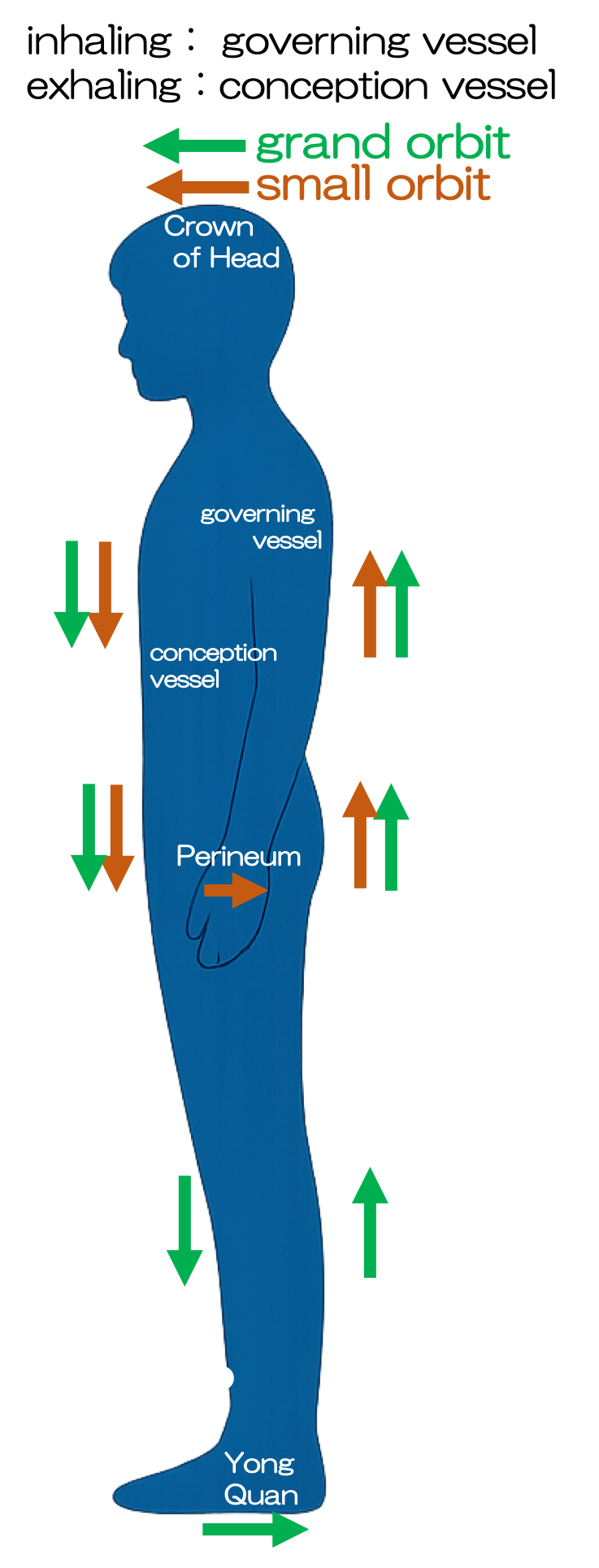
(1) One method of circulating "Ki" within the body involves practicing the Small Microcosmic Orbit (Shōshūten) or the Grand Orbit (Daishūten). In the Small Orbit, "Ki" is moved along a path that runs from the perineum (Huiyin), up the Governing Vessel (Du Mai) to the crown of the head (Baihui), and then down the Conception Vessel (Ren Mai) back to the perineum.
For example, with each inhalation, imagine a small ball of "Ki" (or a short rope of "Ki") rising from Huiyin up the Governing Vessel to Baihui; with each exhalation, let it descend back down via the Conception Vessel.
You may experiment and find a flow that feels natural to you. These orbit techniques are fundamental to most styles of qigong.
(2) When "Ki" is moved through the body via both intention and movement, the practice is called Moving Qigong (Dōkō). While it may resemble ordinary calisthenics on the surface, the movements are much slower and synchronized with breath, unlike typical radio or TV exercises.
What matters most is finding a rhythm and breathing pattern that feels right for you. Over time, as you practice, your body will begin to "teach" you the movements and breathwork that suit you best. The form may change naturally depending on your level of experience and your physical condition at the time.
For reference, I personally attended the classes of Master Shuten Suzuki, who taught Kido Shin Kokyuho (later called Tendo), since 2013, and I continue to attend the successor school following his passing. Master Suzuki himself did not write any books, but Hisahiko Okazaki, who trained at his dōjō, described the atmosphere and activities of the dōjō in his writings.
(3) During Qigong practice, it is important to focus your attention on the practice itself and not become caught up in distracting thoughts. Such thoughts will arise endlessly, one after another, but there is no need to follow them with your attention. At times during Qigong, consciousness seems to enter the realm of intuition. You may suddenly remember something important that you had forgotten but needed to do, or an answer or clue to a problem that had resisted all your efforts to solve it may unexpectedly come to mind. When such insights arise, it is often helpful to make a quick note of them, even during your practice, and reflect on them later. Sometimes remarkably important and useful ideas emerge in this way. From one perspective, healing through the laying on of hands can also be regarded as a form of Qigong. During such healing sessions, similarly valuable insights may spontaneously arise in one's awareness.
(4) Progress in qigong does not come from practicing for long periods only once in a while. Improvement occurs when you practice every day for a short time—perhaps for several tens of minutes—and continue consistently. However, the progress is not gradual day by day. Rather, you may experience a long period with no noticeable change, and then suddenly your level rises one day. Repeating this pattern leads to gradual overall improvement, though it seems there is no final “goal” to reach. In reality, it may not be the level you eventually attain that matters, but the very fact that your level continues to rise. In mathematical terms, if we denote the level by x, then the value of x itself is not what is important; what matters is that its time derivative dx/dt remains positive.
(5) There are as many formal styles of qigong as there are instructors—in other words, virtually limitless variations. However, all styles share the same ultimate goal: a peaceful mind free from self-centered attachments. In this sense, qigong could be considered one path toward cultivating such a state of mind.